[GELDENHAUER, Gerardus].
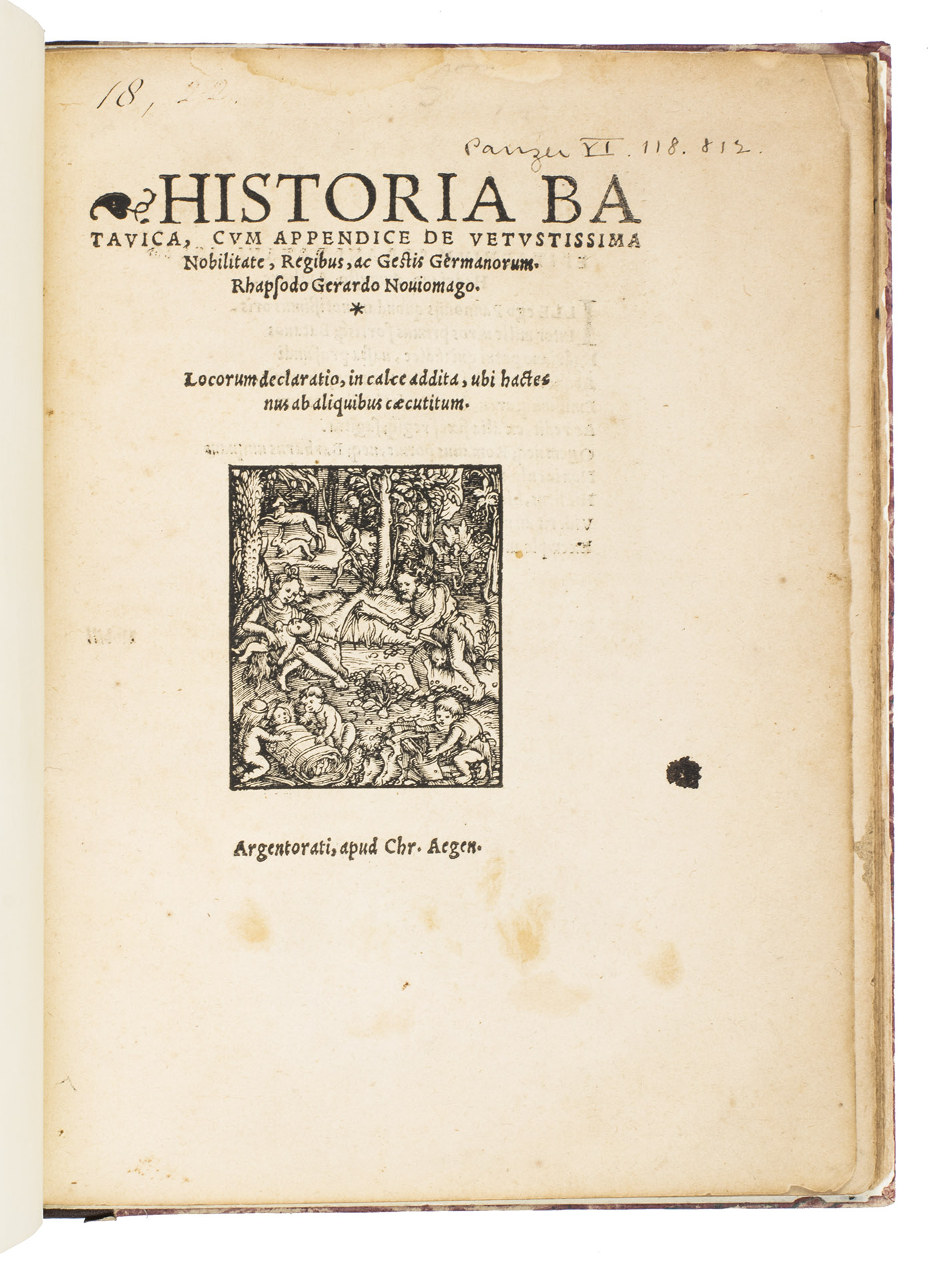
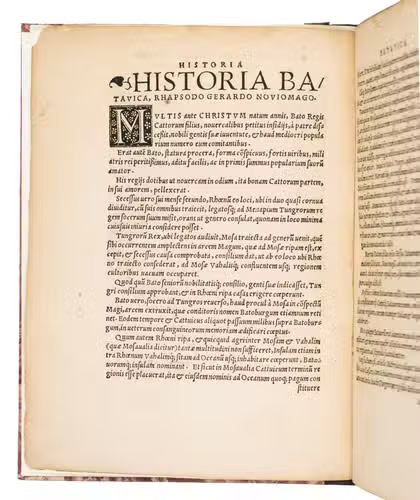
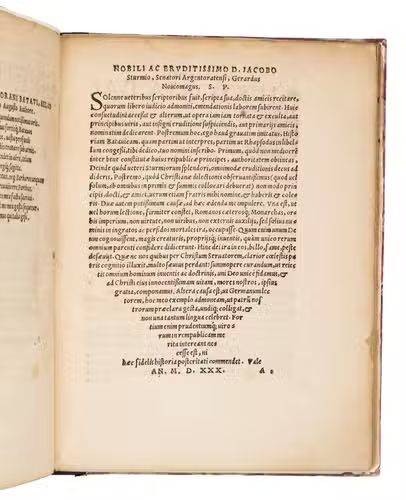
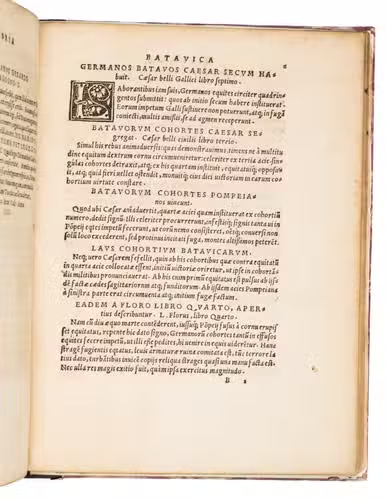
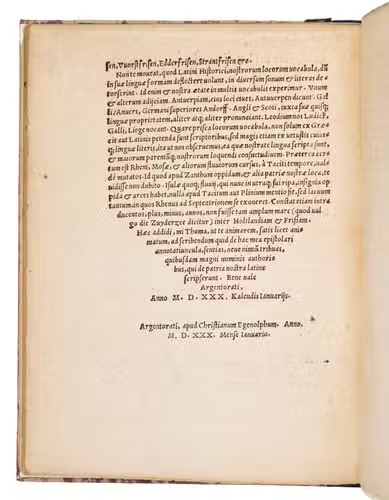
Historia Batavica, cum appendice de vetustissima nobilitate, regibus, ac gestis Germanorum.
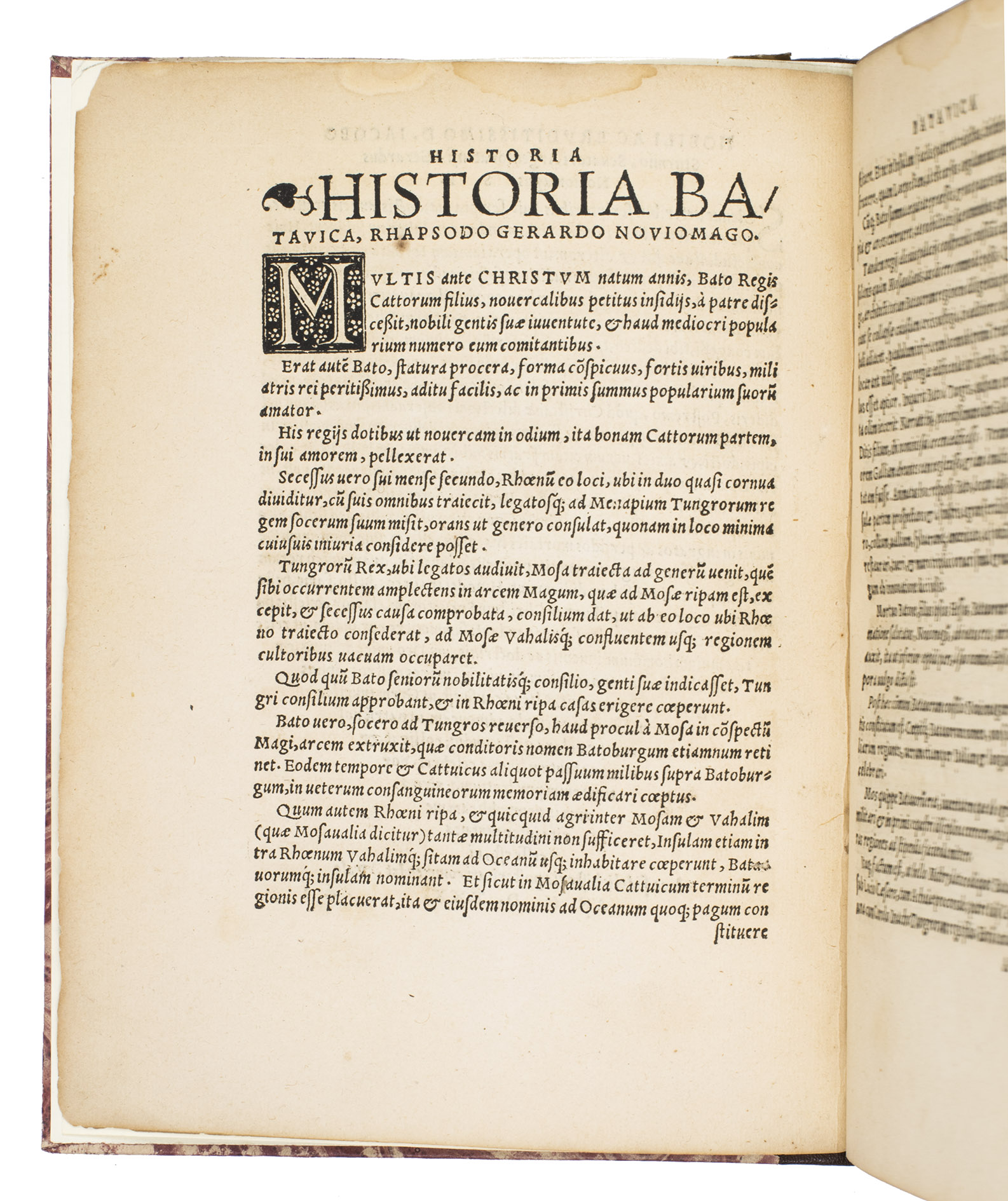
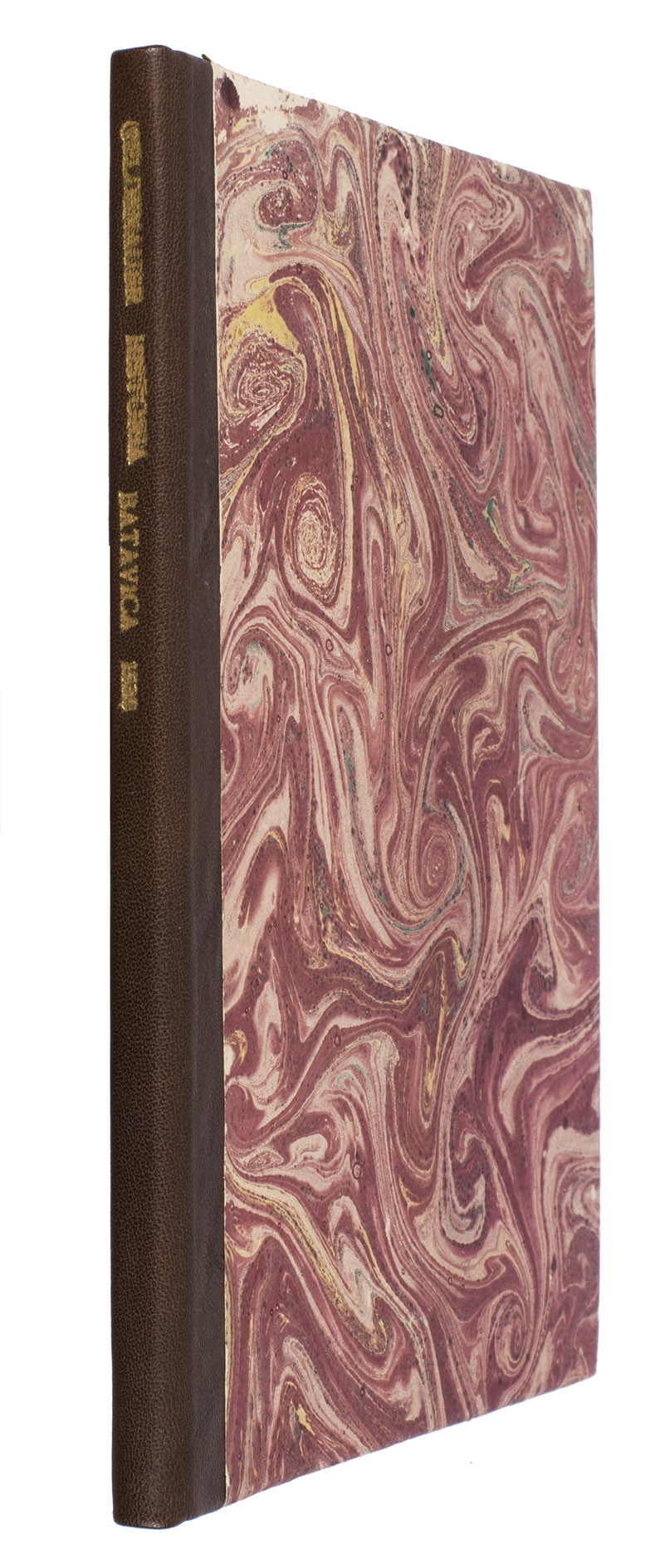
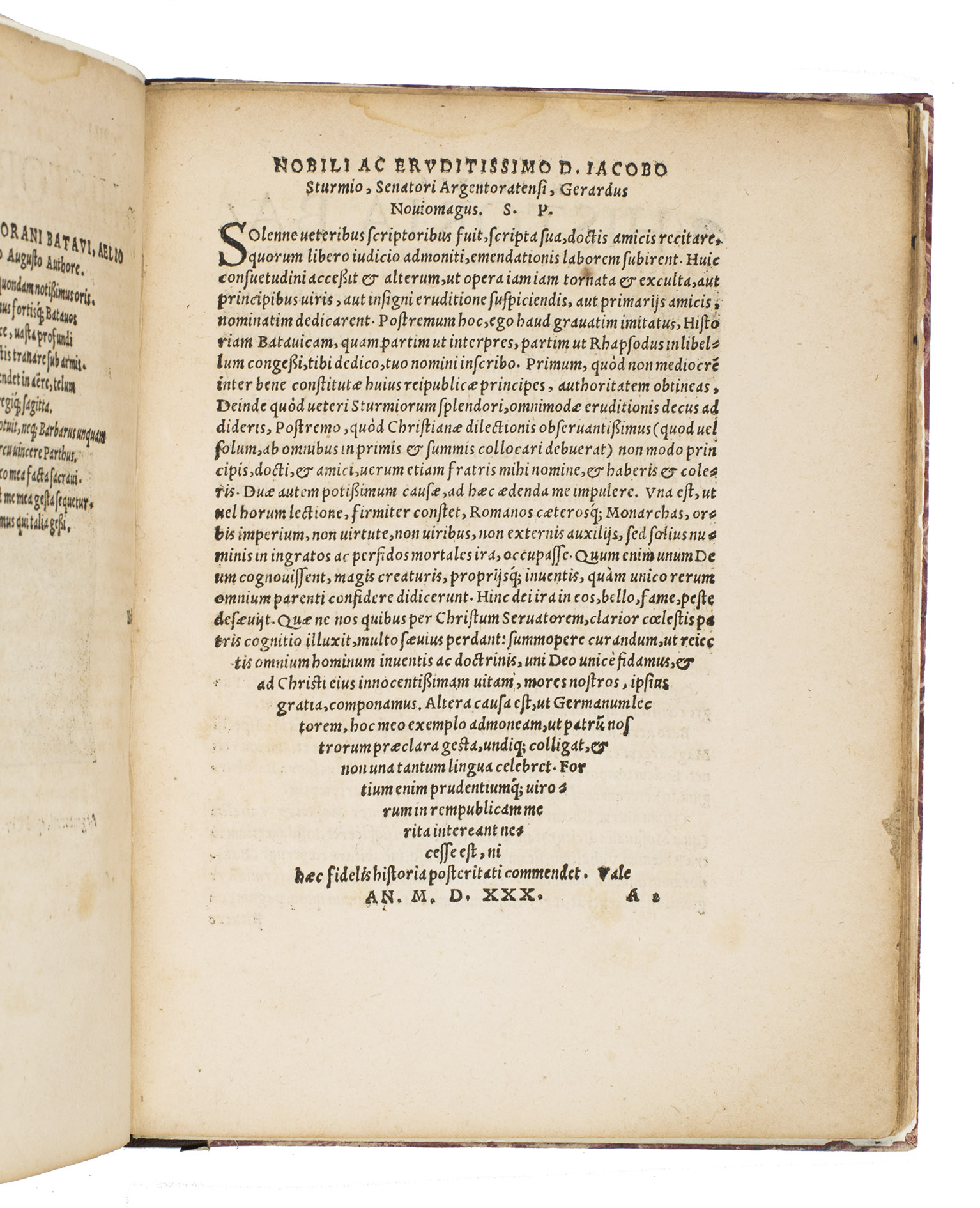
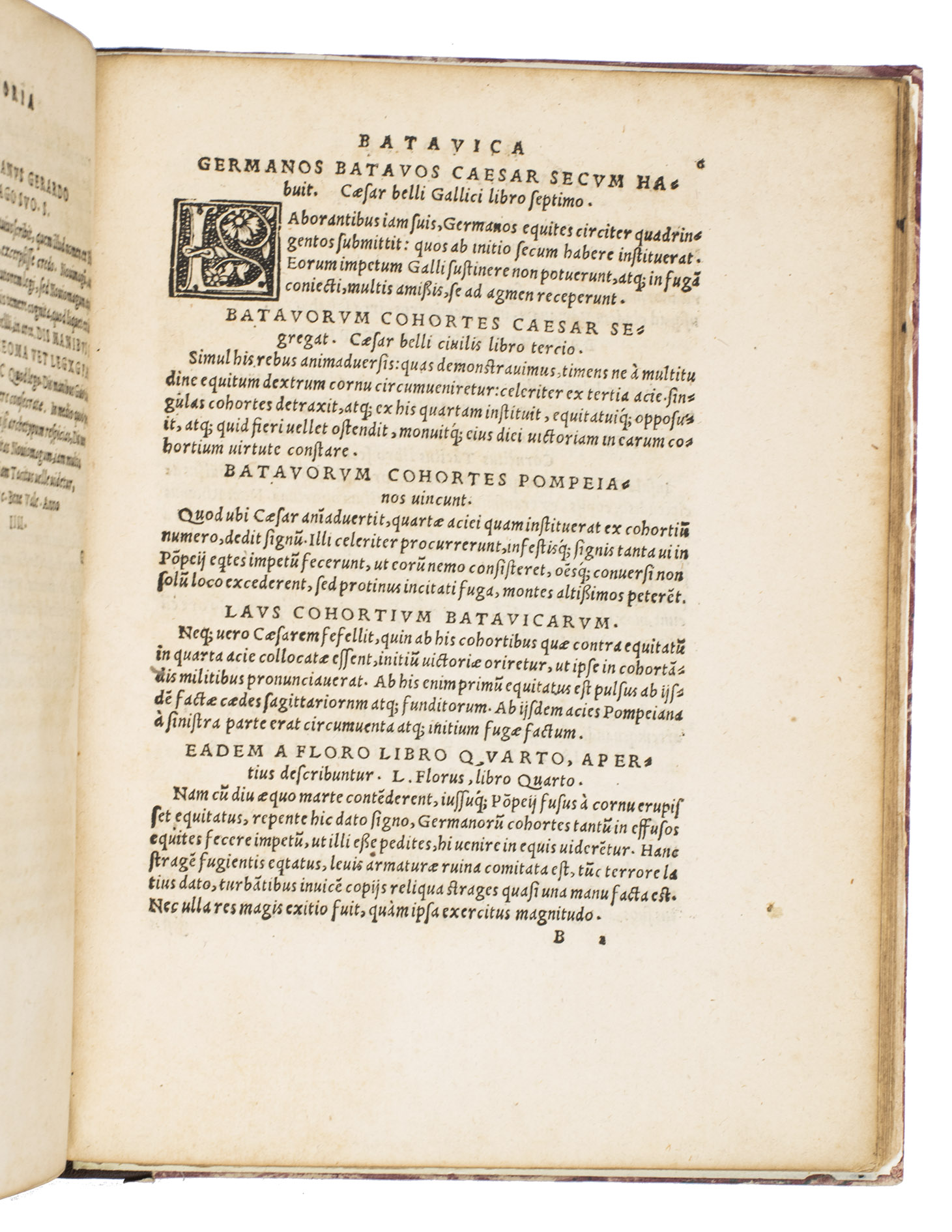
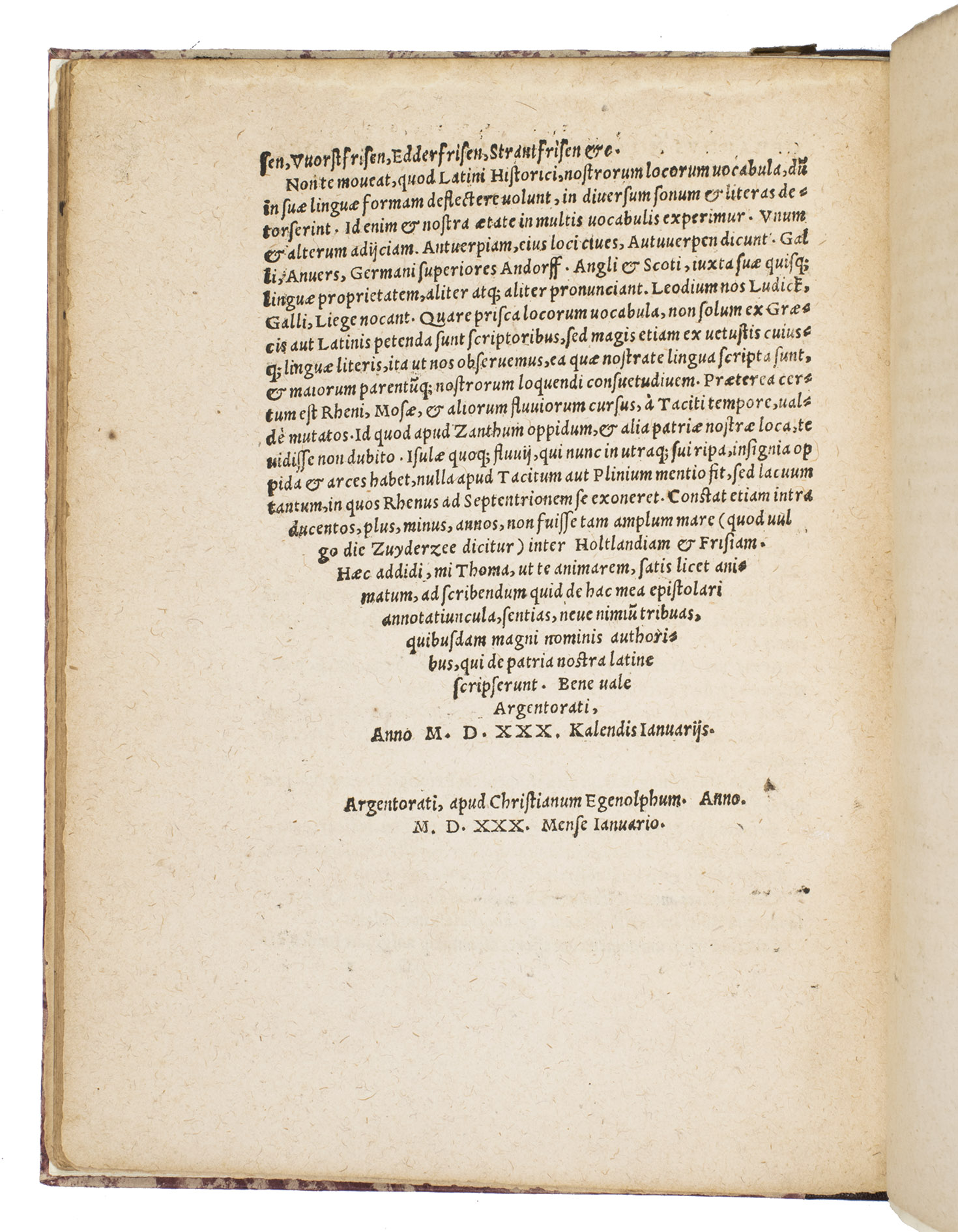
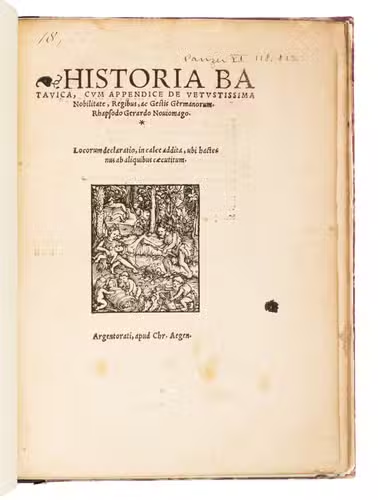
Strasbourg, Christian Egenolph, January 1530. 4to. With an interesting woodcut by Hans Weiditz (or the Petrarch Master, 1495-1536) on the title page, not showing a Batavian Family scene as Kampinga interpreted, but being the printers device of Christian Egenolph, depicting Adam and Eve after the Fall expelled from Paradise (see the extensive description and discussion, including illustr., by H. van de Waal, Drie eeuwen Vaderl. Geschieduitbeelding (1952), I, pp. 157-159), some decorated woodcut initials. Modern half calf. 26, [1] ll.
€ 1,250
The first edition in its original form with the words "in calce" added in the title (meaning the first issue), of an early humanist history of the Netherland and its original inhabitants, the Batavians, from pre-Roman and medieval times till the beginning of the 16th century. The author, Gerardus Geldenhouer from Nijmegen argues that the ancient Batavians were the ancestors of the Dutch people, living not only in Holland but also in the river-region up to Nijmegen (the Betuwe) and even further east, and that they were ancient allies of the Romans. To prove his conclusions, he did not shy away from blending classical sources, including Tacitus, with fabricated documents to construct a heroic early history of the Netherlands. And he was successful: his work has been very influential in establishing the so-called "Batavian Myth" in Dutch and German history. Geldenhouwer has published four related historical works in which he defends the "Batavian thesis" - the present book being the most important.
Gerardus Geldenhouwer (1482-1542) is one of the foremost early Dutch humanists who, after having studied at the Latin School in Deventer under Hegius and having joined the Augistinians, went to Louvain University where he also published his first works among which are a collection of satires in the trend of Erasmus Praise of Folly. He was also active as a corrector for the printer Dirk Martens where he also became a friend of Erasmus. From 1517 until 1524, he was in the service of Philip of Burgundy, an illegitimate son of Philip the Good who was bishop of Utrecht and a patron of the arts, including for the painter Jan Gossaert who played an important role in the introduction of the Italian Renaissance in the North. It was in Utrecht that Geldenhouwer came in contact with Lutheran Protestantism. He left the Augustinians and got married. Six years later he became professor of history and later theology at the newly founded Lutheran University of Marburg where he died in 1542, probably from the plague.
With an annotation on the title page. Slightly browned, some occasional marginal staining at places and a small ink-blot on the title page. Otherwise in good condition. BL, STC German, p. 336; Beyczy & Stegeman, Gerard Geldenhouwer van Nijmegen, Historische werken (1998); Contemporaries of Erasmus, II, pp. 82-84; Enenkel & Ottenheim, Ambitious Antiquitis (2019), Chapter 6, pp. 151-183: The Batavians as ancestors in Early Dutch Humanism: Erasmus, Aurelius and Geldenhouwer; Gerlo-Vervliet, Bibliographie de lhumanisme des anciens Pays-Bas (1972), p. 337; Haitsma Mulier-Van der Lem, p. 178d; NNBW, 6, cols. 550-554; Ritter, p. 991; USTC 663333; VD16 G 1013; not in Adams.
Related Subjects: