NICOLS, Thomas.
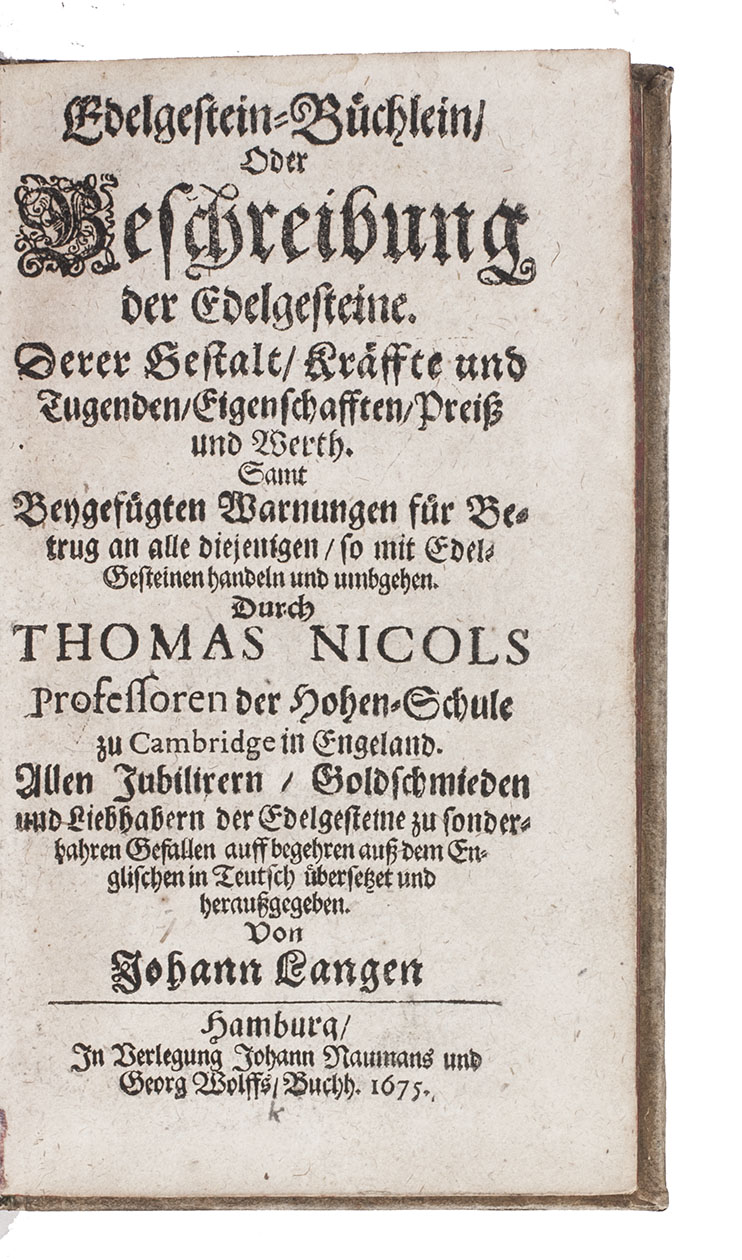
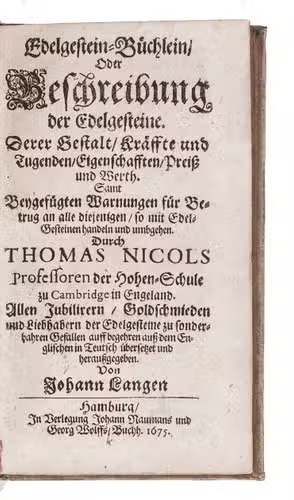
Edelgestein-Büchlein, oder Beschreibung der Edelgesteine. Derer Gestalt, Kräffte und Tugenden, Eigenschafften, Preis und Werth. Samt bengefügten Warnungen für Betrug an alle diejenigen, so mit Edelsteinenen handeln und umbgehen ... Übersetzet und herausgegeben von Johann Langen.
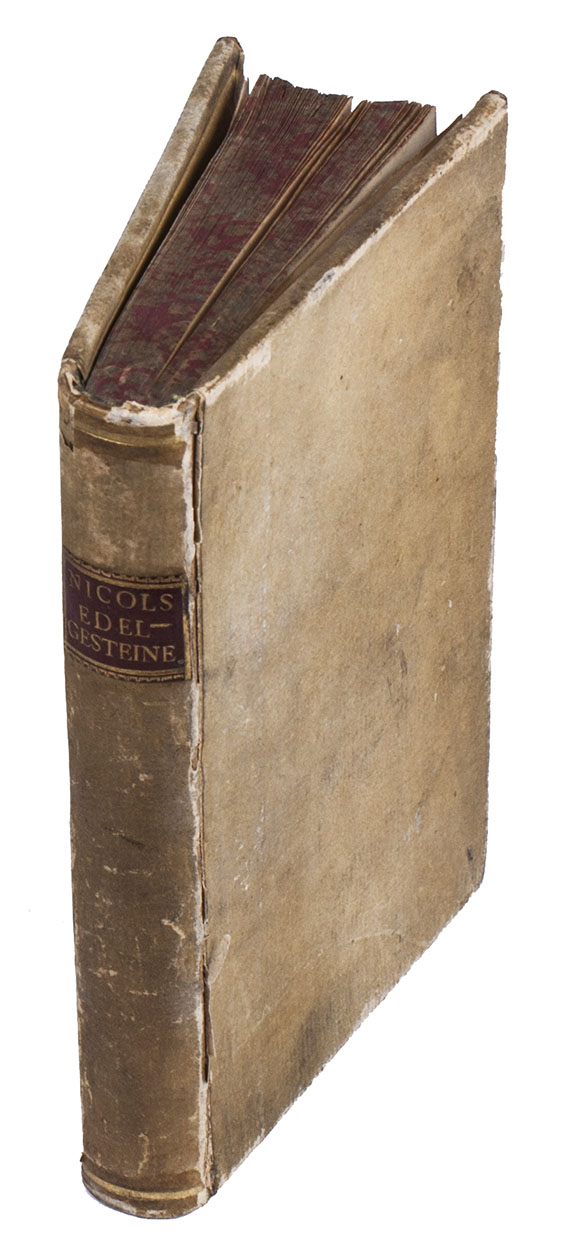
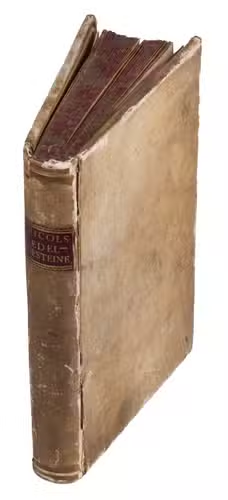
Hamburg, Johann Naumans and Georg Wolff, 1675. 8vo. Paper covered vellum, marbled endpapers. [16], 249, [7] pp.
€ 1,750
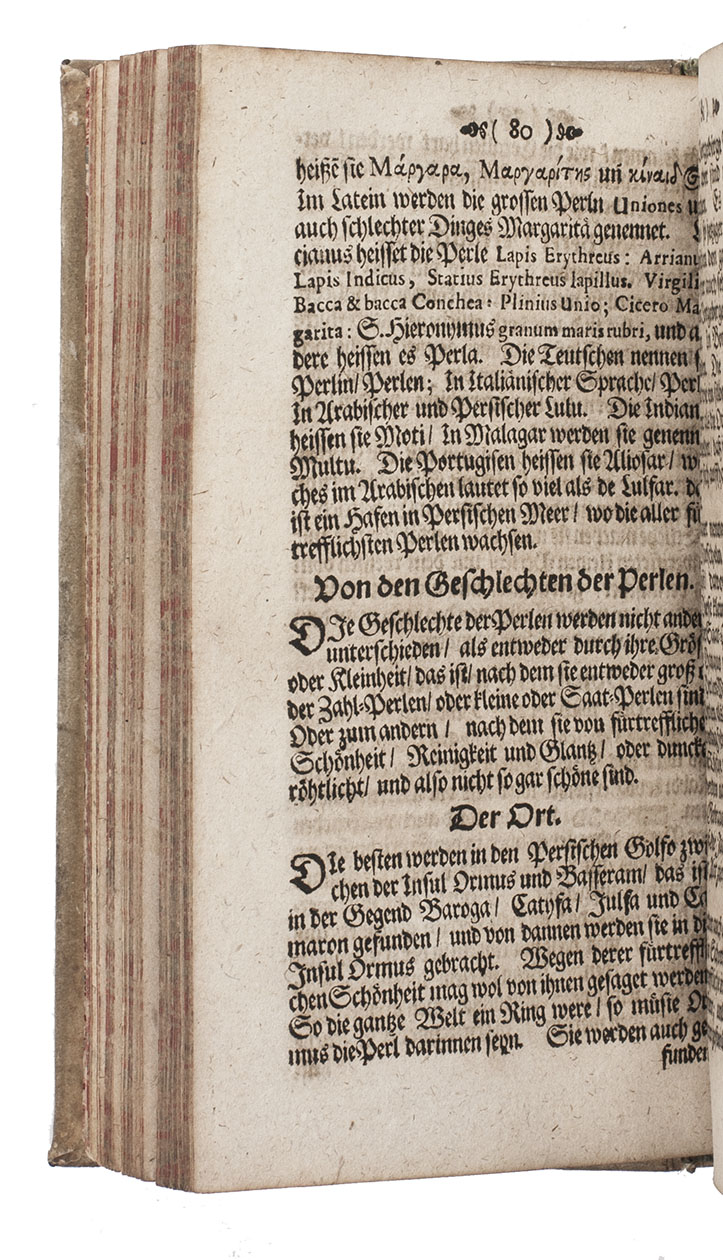
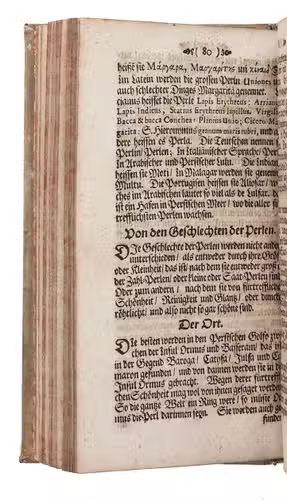
First edition of the German translation of A lapidary, first published in English in 1652 and compiled by Thomas Nicols: ''the first independent gemological book by a British author ... based firmly upon Boetius de Boodt'' (Sinkankas). Nicols lists all the true gems, but also covers fossils, coral, pearls, amber, etc. For each he discusses the forms, appearance, properties (diligently but somewhat sceptically reporting magical, mystical and medical claims), origins, classification, uses, prices, engraving on gems, etc. For pearls he informs us that "the best are found in the Persian Gulf" (English edition), especially near what is now called the Strait of Hormuz (Ormus). "By now the pearl sources of the Gulf, and most particularly Bahrain and Julfar, were very well known to European travellers, scientists and jewellers, who frequently named them as producing the best pearls. One of the most interesting and poetic of such observations is given by the English gemmologist Thomas Nicols in his Lapidary of 1652: ... If all the world were but one ring, Ormus should the Union bring. ... the reference to the Union is a pun, combining a Latin term for pearl, unio, with the joining of the two ends of the ring at the gem" (Carter). Nicols also mentions several other spots in the Arabian Peninsula and Egypt where various gems can be found. Nicols makes an intelligent synthesis of the earlier literature, as well as original contributions primarily in practical aspects related to jewellery, such as enhancing stones with reflective foils or dyestuffs, hardening softer stones, and the related subjects of falsification and adulteration. The 48 page introduction is followed by 89 numbered chapters each devoted to one kind of stone. This translation was already rare by 1727 and regarded as an important book. A second edition appeared in 1734.
Browned throughout, otherwise a good copy. Carter, Sea of Pearls, p. 92; Ferguson, Bib. Chem. II, p. 138 note; Sinkankas 4757; VD 17, 3:302273B; cf. Hoover 610 & 611 (English editions); Ward 1656 (1653 English edition).
Related Subjects: